
- Meet it: learn the word, its meaning and an example, then a quick check.
- Recall it: pick the right meaning with no hints.
- Use it: choose the sentence that uses the word correctly.
- Read it in context: an SAT-style Words in Context question.
- Write it: your own original sentence. You can't fake a sentence.
The method
This is not a word list.
Memorizing word lists has poor returns. Most tutors will tell you that, and we agree. So SATShield does something different: it teaches SAT strategy, and it uses a carefully chosen set of words as the vehicle. Students learn the words most likely to appear on the test by practicing the test.
Which words? The ones with a track record.
The list has 300 words. They were drawn from official College Board practice tests and cross-checked against leading SAT prep resources, then reviewed by a team of experienced SAT tutors. These are words with a documented history of appearing on the test, not words that just sound like SAT words.
Secondary meanings get attention. The SAT likes to test a familiar word on its less common meaning, so words that are tested on more than one meaning can be practiced as separate entries, with example sentences for the meaning that actually shows up.
Strategy is built into every sentence
On the SAT, punctuation is a signal. A colon, a pair of dashes or an appositive phrase often means here comes a restatement. That restatement is usually the definition, hiding in plain sight.
About 40% of SATShield's example sentences use these same cues. Students absorb the pattern long before anyone teaches it as a rule.
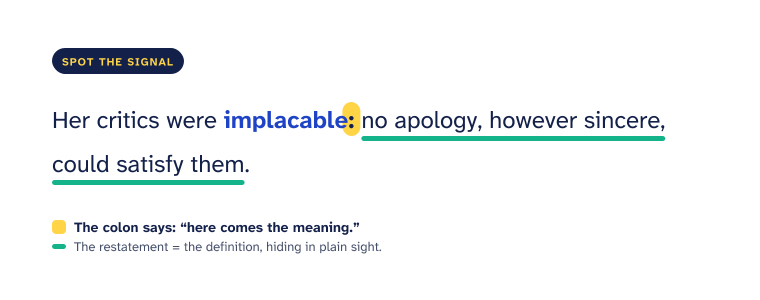
Common signals students learn to spot
| Signal | Example pattern | What it tells you |
|---|---|---|
Colon : | “…was implacable: no apology could satisfy them.” | The explanation is coming next |
Dashes — — | “Her tone — terse, almost curt — surprised us.” | The part between the dashes restates or describes |
Appositive , … , | “The ephemeral bloom, a flower lasting only one day, …” | The phrase renames the word |
| Signal phrases | “in other words,” “that is,” “rather than,” “unlike” | Restatement or contrast is coming |
Five levels. Each one asks for a little more.
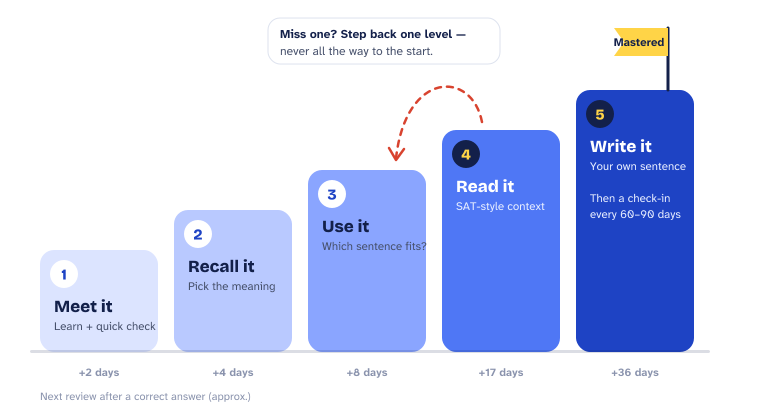
| Level | What the student does | What it builds |
|---|---|---|
| 1. Meet it | Learn the word, definition and example sentence, then a quick check against distractors | Encoding and recognition |
| 2. Recall it | Pick the right meaning with no definition shown | Recall of meaning |
| 3. Use it | “Which sentence uses this word correctly?” | How the word behaves in a sentence |
| 4. Read it in context | An SAT-style Words in Context question | Inference from context, exactly as tested |
| 5. Write it | Write an original sentence (graded with feedback) | Production: the real proof of mastery |
After Level 5, words move to maintenance and resurface every 60–90 days, so they're still there on test day.
Why do students write a sentence if they got the question right?
Because it's the honest measure of mastery. Research on the generation effect shows that information you produce yourself is remembered better than information you pick from options. You can guess your way past multiple choice. You can't fake a sentence. A sentence like “He was implacable” won't pass: it has to show you know what the word means.
The SAT doesn't have “which sentence is correct” questions. Why does SATShield?
Knowing what a word means isn't the same as knowing how it works. At Level 3, students see several sentences and pick the one that uses the word correctly. Along the way they absorb how the word behaves: its part of speech, where it sits in a sentence, what it pairs with, and what it can't do. That's what separates near-synonyms, and telling close words apart is exactly what the SAT's Words in Context questions test.
Why are the wrong answers always other SAT words?
So every question does double duty. Distractors are other words from the list, often the most confusable ones (for example, laud vs. extol vs. commend). Students practice telling close meanings apart, which is the SAT's own technique for building trap answers.
Spaced repetition: why reviews come first
Memory fades fastest right after you learn something, then more slowly. Reviewing a word just before you'd forget it resets that curve and makes the next drop slower. Long-term memory comes from many successful, spaced retrievals over time, not from one big cram.
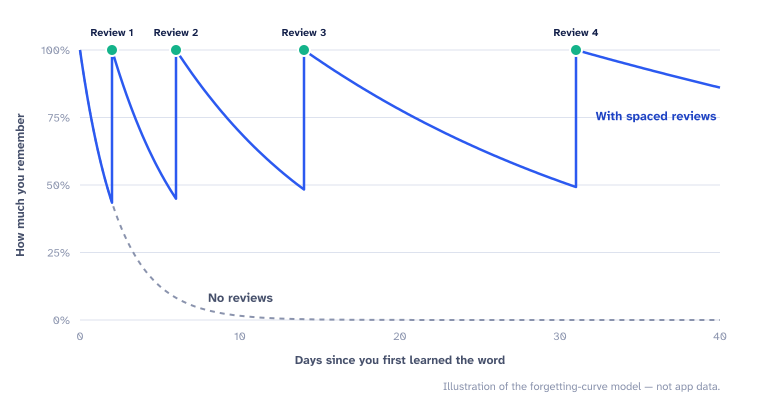
How SATShield schedules
- After each correct answer, the next review gets further away: roughly 2 → 4 → 8 → 17 → 36 days, with a little randomness so reviews don't pile up on the same day.
- Reviews always come first. Each day's session pulls due reviews before introducing new words. If the reviews fill the session, no new words that day, because a review pushed well past its due date silently weakens the method.
- Teach all, then test all. New words are introduced first, then tested in shuffled order, so nobody succeeds by remembering positions.
What happens when a student gets one wrong?
The word drops back one level, not to the beginning. Once a word has climbed a few levels, the student has already proven they know it several times. A single miss is more often a momentary lapse than proof it was never learned. Sending it back to the start would make them re-earn ground they already hold. Dropping one level puts the word where the student actually is, and it comes back sooner.
For Level 5, a sentence that doesn't pass keeps the word at Level 5 and brings it back for another try within a week. After three misses in a row, it drops to Level 4.
A strategy tip before the first Words in Context question
Before the day's first Level 4 question, students see a quick strategy reminder, because practicing a clear sequence of steps is what keeps students from panicking on hard questions on test day:
The floor, and the upside
At minimum, a student who finishes SATShield walks into the test knowing the words most likely to appear on it, recognizing the question formats on sight, and reading punctuation as a signal instead of decoration. They'll have built a daily study habit, and they'll have spent a little less of the year scrolling.
The upside we're working to show is bigger: that this integrated approach makes all of SAT prep more efficient. Read what the research says, and what it doesn't →
Questions about the method
What happens when a student gets a word wrong?
The word drops back one level, not to the beginning, and comes back sooner for review. A single miss after several correct answers is usually a momentary lapse, so a full reset would waste time on a word the student mostly knows.
Why do students have to write a sentence if they already got the question right?
Because writing an original sentence is the honest measure of mastery. Information you produce yourself is remembered better than information you choose from options, and you can guess on multiple choice but you can't fake a sentence.
Where does the word list come from?
The 300 words were drawn from official College Board practice tests and cross-checked against leading SAT prep resources, then reviewed by experienced SAT tutors. They're words with a documented history of appearing on the test.
Is vocabulary even on the digital SAT?
Yes. The Reading and Writing section includes Words in Context questions that ask students to choose the most precise word for a passage. Vocabulary also shapes how quickly students understand passages and math word problems. SATShield teaches the words through those same formats rather than as a list to memorize.